
For Halloween, Louisville Ballet brings new score, choreography, stagecraft to ‘Frankenstein’

By Evie Ewen, Arts Angle Reporter
Louisville Collegiate School, Class of 2029
“Frankenstein” is more than just a scary story. Beneath the suspenseful atmosphere of Louisville Ballet’s upcoming production lies deeper meaning and tragedy that explores what it means to be human.

Nikolas Gaifullin as The Creature during a rehearsal for the Louisville Ballet’s “Frankenstein.” Photo by Kateryna Sellers. Courtesy Louisville Ballet.
Set to perform on Halloween, Louisville Ballet’s “Frankenstein” aims to impress with its original choreography, stagecraft, and message.
Artistic Director Anthony Krutzkamp, who choreographed the full-length ballet, describes the upcoming performance as “visually striking, emotionally intense, and deeply theatrical.”
Inspired by Mary Shelley’s iconic novel, “Frankenstein” is the story of an ambitious yet obsessive scientist named Victor Frankenstein who brings a grotesque creature to life. Part science-fiction, part gothic horror, the novel explores themes like parental abandonment and social rejection that remain relevant more than 200 years after the book’s original publication.
“At its heart,” says Krutzkamp, “‘Frankenstein’ is about humanity, responsibility, isolation, and our desperate need to be loved.”
For the first time, “Frankenstein” will be choreographed to the music of John Adams, a contemporary Pulitzer Prize- and Grammy-award winning composer known for his expressive and dramatic musical style. Krutzkamp and the company librettist, Justin Gray, chose “Fearful Symmetries,” one of many of Adam’s works, for “Frankenstein,” which is at once grounded and electric, driven forward by the triumphant call of brass instruments and united by a continuous beat.

Justin Gray (librettist), Anthony Krutzkamp (Artistic Director), Mikelle Bruzina (Senior Rehearsal Director) during a rehearsal for the Louisville Ballet’s “Frankenstein” (left to right). Photo by Kateryna Sellers. Courtesy Louisville Ballet.
“Adam’s music has an incredible ability to create psychological tension,” explains Krutzkamp, and it can suggest “obsession and emotional instability without telling the audience exactly what to feel.”
The challenge for Krutzkamp was creating compelling choreography that works in tandem with John Adams’ rich music.
“The movement,” says Krutzkamp, “will alternate between highly physical, athletic choreography and moments of extraordinary vulnerability.”
The choreography aims to convey The Creature’s evolution from newly-aware to deeply sentient. He begins, says Krutzkamp, by simply “discovering his body,” but develops into a “character capable of expressing love, rage, and despair.”
The choreography when combined with stagecraft is designed to make the story more powerful. The lighting, says resident Lighting Designer Jesse Alford, can “elevate all of the emotions.”
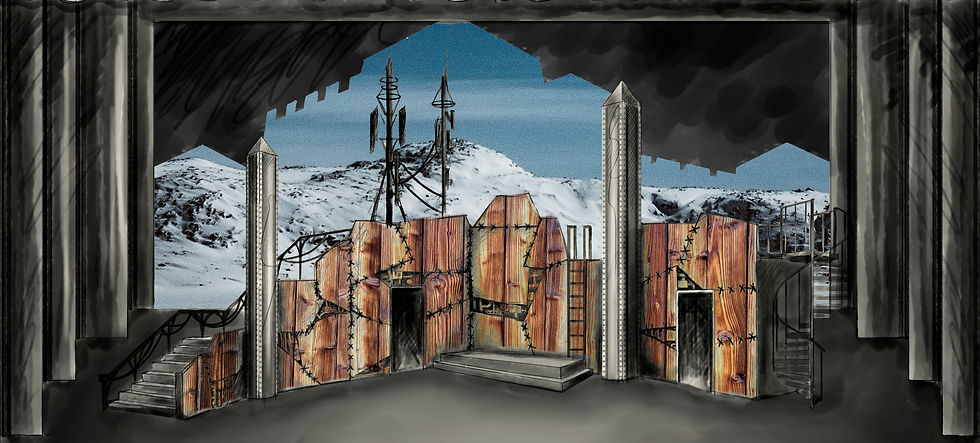
An early set rendering for the Louisville Ballet’s production of “Frankenstein.” Photo by Hallie Beard. Courtesy Louisville Ballet.
Alford seeks to create a sense of quiet unease, as the familiar, every-day settings that the story primarily revolves around have strong potential to “linger with you in the wrong way.” Alford says he wants the production to feel "surprisingly scary.” He uses tools like innovative LED tape hidden behind parts of the set to create an immersive glow and carefully positioned stage lights intended to give The Creature an imposing stance.
Not only is lighting essential in creating the general atmosphere of a production, but Alford says it also influences how the audience perceives the characters. In the case of The Creature, Alford explains that an overlit stage makes him feel small, and therefore not frightening.
Costumes are another integral part of stagecraft. Louisville Ballet Costume Director Molly Duke believes the performers' attire play a crucial role in the narrative because it allows the audience to make the necessary plot connections as they watch the story unfold.
Especially for a show like “Frankenstein,” Duke says costumes “keep key characters and key groups together based on color” and make a complicated story easier to follow.
Dukes’s detailed thought in her costume design sheds light on the deeper nuances of a story. For example, Duke used baby pinks and blues to hint at the angelic nature of

Kayleigh Western, Joe Henn, Nicholas Bradley Gray, Anna Ford (left to right). Photo by Kateryna Sellers. Courtesy Louisville Ballet.
Elizabeth, Victor Frankenstein’s fiancée. These pastel colors will contrast with Victor’s moody monochromatic color palette, which Duke explained represents Victor's “madness and [Elizabeth’s] salvation for him.”
Meanwhile, for the De Lacey family, whom The Creature secretly observes to learn how to be human, Duke said she dressed them in “reds and yellows and browns because they are such a key factor in the humanity of the creature.” These earthy tones are intended to make the family feel welcoming and hospitable, as The Creature absorbs integral aspects of humanity through their familial interactions.
Yet these separate parts of a production — the music, the choreography, and the stagecraft — only work if they coalesce. “This work could not happen if we were not collaborative,” says Alford. “It relies on good communication, which is so much easier when you have a good relationship with the people that you're working with.”
He echoed Duke, who explained that “keeping constant open communication as things shift and come to fruition” is key to successful collaboration, and therefore key to a successful show.

Pieces of the “Frankenstein” set that Jesse Alford ‘s lighting design will highlight with an immersive glow. Photo by Hallie Beard. Courtesy Louisville Ballet.
At the time of its original publication in 1818, Shelley’s novel addressed a fear of the capabilities of technology, and that theme remains strikingly relevant in our world of advancing artificial intelligence.
“Like Victor Frankenstein,” says Krutzkamp, “we are constantly asking what we are capable of creating, but perhaps not spending enough time considering what responsibilities come with those creations.”
Krutzkamp says the story also poses other questions. “It challenges us to consider whether monsters are born or made,” he says, “and whether compassion might have changed the outcome of this tragedy.”
Far beyond a simple Halloween thriller, “Frankenstein” invites its audiences to reflect on something bigger. “I hope audiences leave the theater not simply remembering the spectacle,” says Krutzkamp, “but thinking about their own responsibilities to one another.”


Comments